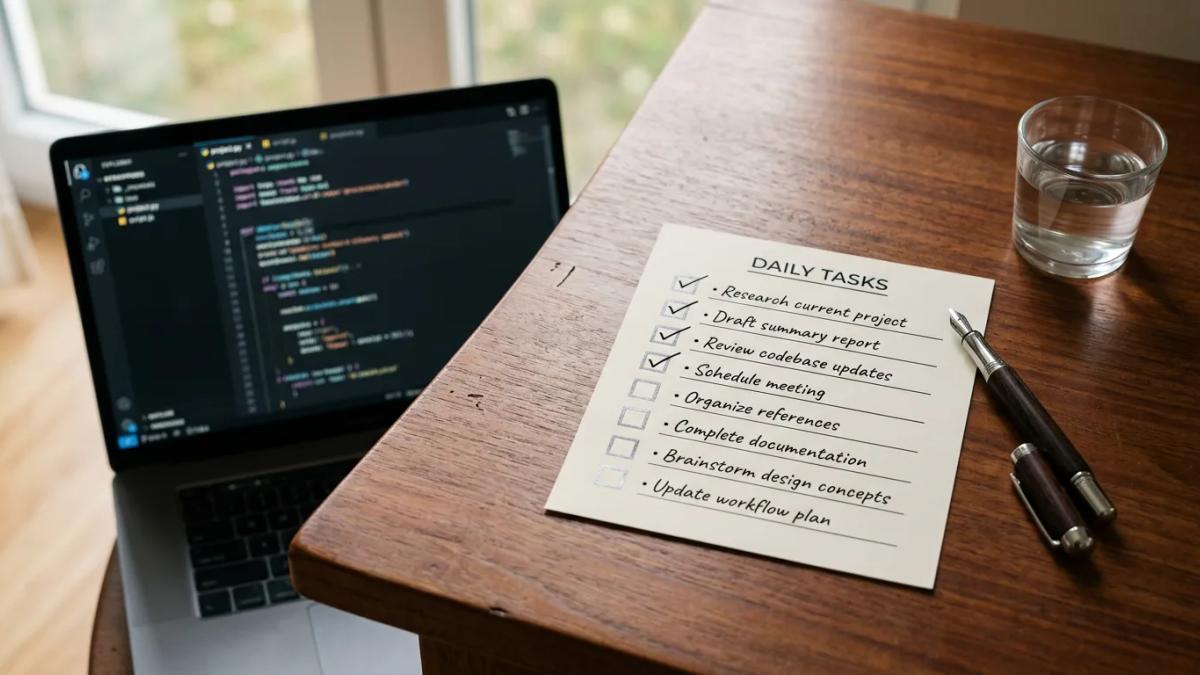
GEO for PR means writing and publishing press releases, bylines, newsroom pages and media kits so AI engines can retrieve and cite them. Run a seven-step checklist before anything goes live: lead with the answer, confirm AI search crawlers can reach the site, name and date every source, format each content type for retrieval, add a review step, brief the client, and audit every quarter.
For the definition and the research behind Generative Engine Optimization, read the Generative Engine Optimization pillar. This page is the working checklist. Platform detail is in how to rank in ChatGPT search and Google AI Mode optimization.
1. How should every piece of PR content open?
Every piece should open with the news, the claim or the answer in sentence one, with context after it. An AI engine that retrieves a page tends to quote its first substantive statement, so a lead built from throat-clearing gives the engine nothing to quote.
The example below uses an invented company and invented figures to show the change.
| Version | Lead |
|---|---|
| Before | "ACME Corp., a leading provider of enterprise software solutions, today announced the launch of its innovative new platform designed to help businesses streamline operations." |
| After | "ACME Corp. launched Vertex, a supply-chain platform that cut logistics costs by 31 percent in pilots with three retailers, said CEO Sarah Chen." |
The second lead names a product, a result, a source and an executive, so a reader or an engine can repeat it accurately. The format guidance for releases is in press release format.
2. Which AI crawlers should the client's robots.txt allow?
The client's robots.txt should allow the crawlers that power AI search and user-requested visits, and the client should decide separately about model-training crawlers. If robots.txt blocks the search crawlers, nothing else on this checklist can work, because the engine never fetches the page.
| Crawler | Operator | What it does | Recommended setting |
|---|---|---|---|
| OAI-SearchBot | OpenAI | Builds the ChatGPT search index | Allow |
| ChatGPT-User | OpenAI | Fetches a page when a user asks ChatGPT to open it | Allow |
| PerplexityBot | Perplexity | Builds the Perplexity search index | Allow |
| Claude-SearchBot | Anthropic | Supports Claude's web search | Allow |
| Googlebot | Crawls for Google Search, which also feeds AI Overviews and AI Mode | Allow | |
| Bingbot | Microsoft | Crawls for Bing search | Allow |
| GPTBot | OpenAI | Collects content for model training | Client's choice |
| ClaudeBot | Anthropic | Collects content for model training | Client's choice |
| Google-Extended | Controls use in Gemini training and grounding | Client's choice | |
| Applebot-Extended | Apple | Controls use in Apple model training | Client's choice |
The table follows the operators' crawler documentation as summarized in independent robots.txt guides checked in October 2026. Vendors rename and add crawlers, so confirm the current names before you change a client's file.
Why it works: an AI search product can only cite a page that its search crawler has fetched. The Rank4AI robots.txt bot checker (verified June 11, 2026) lists OAI-SearchBot as OpenAI's search crawler and GPTBot as its separate training crawler, so a client can block GPTBot and stay citable in ChatGPT search. The Arrow AI crawler guide (October 2026) reports that Google says Google-Extended does not affect Google Search or AI Overviews, which follow Googlebot.
Ask for the robots.txt file at onboarding, read it, and escalate any disallowed search crawler. Corporate newsrooms usually sit on the main company domain, where IT controls the file. A privacy review can lead IT to block every AI crawler without telling the PR team.
3. How do you cite sources in every piece?
Cite sources by putting four things in every claim: a named executive, a dated event, a checkable number and a primary source.
- Use the executive's full name, title and company instead of "a company spokesperson."
- Give a date such as "in the second quarter of 2026" instead of "recently."
- State a figure that a reader can verify, such as revenue, a percentage, a user count or a funding amount.
- Link to the primary source, such as the study or the filing, not a blog post that summarized it.
Do this because a named, dated, checkable claim is easy to quote accurately. Mechanism not yet published: no engine documents how it weighs these elements, so treat the rule as editorial practice that also improves the odds of being cited. How engines choose sources is covered in how AI engines decide what to cite.
4. How should each PR content type be formatted?
Each PR content type needs its own treatment, because the formats differ in what a reader or an engine looks for first.
| Content type | What to do |
|---|---|
| Press release | Lead with the quantified news, put the full executive quote with name and title in paragraph two, and close with a boilerplate that describes the company in plain terms. See press release boilerplate and AI press releases. |
| Executive byline | Write the headline as the question a buyer would type, such as "How should CPG brands approach retail media in 2026?" End with a bio that gives the author's role and one link. |
| Newsroom page | Publish a reverse-chronological archive with a date, headline and two-sentence summary for each release. Repeat a short company description on every release page and add an FAQ such as "What does the company do?" See how to create an effective press room. |
| Media kit | Publish it as an HTML page, not only a PDF, with an executive biography section and a short key-facts table covering founding date, headquarters and employee count. See press kit examples. |
| Crisis statement | Name the executive speaking, state the date and the specific issue, and give one concrete action. Publish it quickly, because the first credible statement often shapes what gets repeated. See the Crisis Statement Template. |
5. How do you build GEO into the pre-publication workflow?
Build GEO into the workflow by adding a review step before client approval, so the client sees content that is already optimized. Without a gate, teams agree that GEO matters and then approve content through the same process they used before.
- Brief the writer with an answer-first structure and a prompt-style headline.
- Have the account lead check for named sources, dated claims and quantified results.
- Run the piece against this checklist before it goes to the client. It takes about five minutes.
- Send the client the version that already passes.
- After publication, confirm the live page loads, robots.txt has not changed, and schema markup renders in Google's Rich Results Test.
6. How do you brief a client on GEO?
Brief a client in business terms, with their own category prompts on screen. Type "best enterprise CRM for mid-market companies" or the client's equivalent into ChatGPT in the meeting. If a competitor appears and the client does not, the client understands the issue without any theory.
Follow with a baseline: the client and two competitors across twenty category prompts. Numbers move a project from interesting to approved. Present GEO as how you write everything, not as a separate deliverable. The measurement method is in AI brand monitoring, and the metric is defined on the Citation Share page.
7. How often should a PR team audit GEO performance?
Audit GEO quarterly at a minimum, and per campaign when the client is active. Each audit covers four checks.
- Pull the client's robots.txt and confirm that no AI search crawler has been blocked since the last check.
- Run the client's twenty most important prompts through ChatGPT, Perplexity, Claude and Gemini, record which brands appear, and compare with the last quarter.
- Score the last quarter's published content for answer-first leads, named sources and quantified claims.
- Confirm that Organization, Person and Article schema still renders on the newsroom and key landing pages, since CMS updates can break it.
Deliver the result as a one-page scorecard with the number and the action. If a robots.txt change cut visibility, flag it at the top.
What should a PR team do first?
A PR team should pull each client's robots.txt this week and confirm that the search crawlers in step 2 are allowed. Then rewrite the next release lead to open with the news, and schedule the first quarterly audit.
Where does GEO for PR fit in the rest of this site?
GEO for PR is the operating layer between the discipline pages and the press materials. For the discipline, start with the GEO pillar and the AI Communications pillar. For press work, see media relations and earned media.
FAQ
What is GEO for PR?
GEO for PR is Generative Engine Optimization applied to public relations content. It structures press releases, bylines, newsroom pages and media kits so that AI engines such as ChatGPT, Claude, Gemini and Perplexity can retrieve and cite them.
Does blocking Google-Extended remove a page from AI Overviews?
No. Google-Extended controls the use of content in Gemini training and grounding. AI Overviews are part of Google Search and follow Googlebot, so blocking Google-Extended does not remove a page from them.
Can a client block GPTBot and still appear in ChatGPT search?
Yes, if the client allows OAI-SearchBot. GPTBot is OpenAI's training crawler and OAI-SearchBot is its search crawler, and OpenAI documents them as separate.
Originally published August 2026. Rewritten October 2026.